
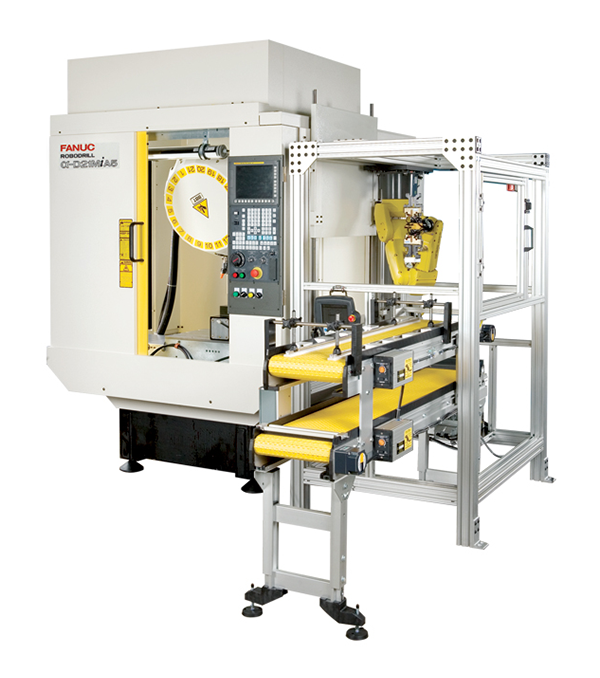
Automated 5-Axis Machining: What the Fanuc Robodrill Makes Possible for Your Shop
Here’s a question we hear from shop owners all the time: “How do I produce more parts without adding more people?”
Skilled machinists are harder to find and even harder to keep. Customers are demanding faster turnaround and tighter tolerances. And the old way of doing things isn’t built for where manufacturing is headed.
That’s exactly the gap the Fanuc Robodrill was designed to fill. When you pair it with the right automation, a 30% reduction in cycle time is just the starting point — shops are also running lights-out weekends, deploying one operator across multiple machines, and producing parts during hours that used to go dark.
If that sounds like the kind of operation you want to run, here’s what you need to know.
What Is a Fanuc Robodrill?
The Fanuc Robodrill is a compact 5-axis machining center that punches well above its weight — capable of handling everything from aluminum and steel to Inconel and other difficult to machine materials across a wide range of industries and applications. We’ve seen it machine complex aerospace components, defense related components with tight GD&T, and even hardened workpieces that most people wouldn’t expect a machine in this class to take on. If the part physically fits in the work envelope, the Robodrill is almost always the right machine for the job, and it will do it faster than what you’ve probably got on the floor today.
Why Automated 5-Axis Machining Starts with the Robodrill
Automation only works as well as the machine tool behind it. If your equipment can’t hold accuracy consistently from part to part, you’re risking an entire untended run of them before anyone notices. That’s why automated 5-axis machining has to start with a machine tool you can trust to perform the same way on part one as it does on part five hundred.
The Tool Changer Difference: Why Fewer Moving Parts Matter
Ask any experienced machinist what causes the most headaches on a conventional machining center, and there’s a good chance the automatic tool changer (ATC) will come up.
On most machines, the ATC uses a swing arm mechanism to grab the current tool, rotate, swap it out, and insert the new one. It works, but it’s mechanical, it moves a lot, and it relies on a series of switches and sensors that can be finicky — all of which need regular alignment and care to stay dialed in. By some estimates, that swing arm and the components around it account for 20 to 25% of all maintenance issues on conventional machine tools. If you’ve owned these machines for a while, that number probably doesn’t surprise you.
The Fanuc Robodrill takes a different approach entirely. There is no swing arm. Instead of swinging the tool out and back, the machine simply moves up into the tool magazine, the magazine rotates to the next tool, and the machine comes back down. The entire tool change happens in 0.7 seconds. Less than a second. And because there’s no swing arm in the equation, there’s a whole category of maintenance issues that just doesn’t exist.
Automated 5-Axis Machining in the Real World: Lights-Out Production
The Robodrill is designed to pair seamlessly with automation cells, and when you make that connection, the machine doesn’t need a dedicated operator standing next to it all day. Your most experienced people, the ones who can troubleshoot a program, change tooling, and run multiple processes, can spend their shift doing exactly that kind of high-value work while the machine runs itself.
Here are some real examples from shops running Robodrills with automation today:
One operator, four machines.
One shop has a single skilled technician who moves between four Robodrill cells throughout his shift. He’s making process adjustments, swapping tooling, checking quality — the things that actually require a trained person. The machines handle the production.
20+ hours untended.
Another shop regularly loads their cells up and walks away. The machine runs through the night and well into the next day, consistently producing parts without anyone present. We had a conversation with a shop just recently that had run 20 hours straight without touching the machine.
29 hours. Never touched it.
A different shop pushed even further — 29 consecutive hours of untended operation. Not a single intervention from start to finish.
72-hour weekend runs.
This one is probably the most striking. A shop we work with uses their workweek for inspections, process improvements, and setup work. On Friday, they load the cells, flip the switch, and let the machines run all weekend, Friday, Saturday, Sunday, untended. The lights go out. The green lights on the machines stay on. Come Monday morning, there’s a weekend’s worth of production waiting for them.
What makes this level of untended operation possible isn’t some complicated bolt-on system. The Fanuc 31iB5+ control that comes standard on the Robodrill also serves as the interface for the automation. There’s no separate controller to learn, no secondary software to troubleshoot. The operator sets the schedule right on the machine screen, turns everything green, and walks away. For shops that have been hesitant about automation because of complexity concerns, that simplicity is often the thing that changes the conversation.
Choosing the Right Robodrill: JSC Pro, Plus K, and Plus E Explained
There are three primary Robodrill systems, and picking the right one comes down to understanding two things: how much volume you’re moving, and how you’re holding the part.
Job Shop Cell (JSC Pro) and Plus E — These are built for high-volume raw material loading. The setup is straightforward: raw material goes in on one end, finished parts come out the other, and the robot handles the loading and unloading continuously. An operator loads trays of raw material every couple of hours, or every eight hours, and keeps the system fed. If you’re running hundreds of parts and your primary constraint is just getting material in and complete parts out efficiently, this is the configuration.
Plus K, Plus K60, and Plus K Max — These systems are designed for lower-volume, high-mix work. Instead of just feeding raw material, the robot handles a pallet with the part already fixtured exactly how you need it. If you have complex geometry, a forging with a tricky shape, a defense component that has to be gripped a very specific way, or a part that requires multiple operations before it’s complete, the Plus K family gives you the control you need. We see these frequently in aerospace, defense, space, medical, and satellite component work.
A good example of where this distinction really matters: if you’re producing automotive brackets by the thousands, the JSC Pro is almost certainly your answer. If you’re machining satellite components that need to be fixtured in a specific orientation, held to very tight tolerances, and potentially run through an op 20 and op 30 before they’re done, the Plus K Max is the right tool. The conversation we have with shops isn’t “here’s what we sell” — it’s “what does your production flow actually look like, and what system fits that?”
Frequently Asked Questions
Do I have to purchase a robot to automate with the Fanuc Robodrill?
No — simply switching to the Robodrill is itself a form of automation. The machine’s speed, precision, and tool changer design mean it requires significantly less operator oversight than a conventional machining center. Most shops see that 30% cycle time reduction just from the switch alone, before a robot ever enters the picture. When you’re ready to take automation further, the Robodrill is designed to integrate seamlessly into an automation cell — but that’s a next step, not a requirement on day one.
What industries is the Robodrill a good fit for?
The short answer is most of them. Aerospace, defense, space and satellite components, automotive, mold, medical device, recreational firearms and building materials are all industries where we’ve seen the Robodrill perform well. The more relevant question is usually whether the part fits in the machine’s work envelope — if it does, the Robodrill is almost always the right call.
How difficult is it for operators to learn the Robodrill?
Not difficult at all for most shops. The Robodrill runs on the Fanuc 31iB5+ control, which is the same control family that holds roughly 65% of the CNC market. If your operators have run a Fanuc system before — and there’s a good chance they have — the interface is already familiar. Programming logic transfers, startup time is shorter, and you’re not asking your team to learn something from scratch.
Ready to See If the Robodrill Is Right for Your Operation?
The Robodrill isn’t the answer for every shop or every part, but if the geometry fits and you’re serious about getting more production out of the labor you have, it’s worth a real conversation. Not a sales pitch. A conversation about the trajectory of your business, your parts, your volume, your current workflow, and where the opportunities actually are.
That’s how Maruka approaches it. We’ve been doing this for a long time, and the best outcomes we’ve seen come from shops that let us dig into how they actually operate before we start recommending equipment. We look at your cost of ownership today, your bottlenecks, your goals — and then we tell you honestly what makes sense. If you’re curious what automated 5-axis machining could look like for your specific situation, reach out to our team. We’re happy to start with a conversation.