







New vs. Used CNC Machine: What Every Shop Owner Should Know
May 8, 2026
Automated 5-Axis Machining: What the Fanuc Robodrill Makes Possible for Your Shop
June 2, 2026
Simple CNC Automation Solutions: Maximizing Revenue Per Person
When most manufacturers hear the word automation, they picture something that belongs in a tier-one automotive plant: massive robotic cells, seven-figure price tags, and an integration project that takes the better part of a year.
For smaller job shops running a variety of parts in small quantities, automation can feel a little out of reach. The good news is that there are a variety of simple, low-cost automation solutions that any manufacturer can implement and maximize their revenue without adding new machines or machinists.
Low-Cost CNC Automation Solutions
One of the biggest misconceptions we encounter is the belief that automation requires huge capital investment and only pays off if you’re running your machines around the clock. This couldn’t be further from the truth.
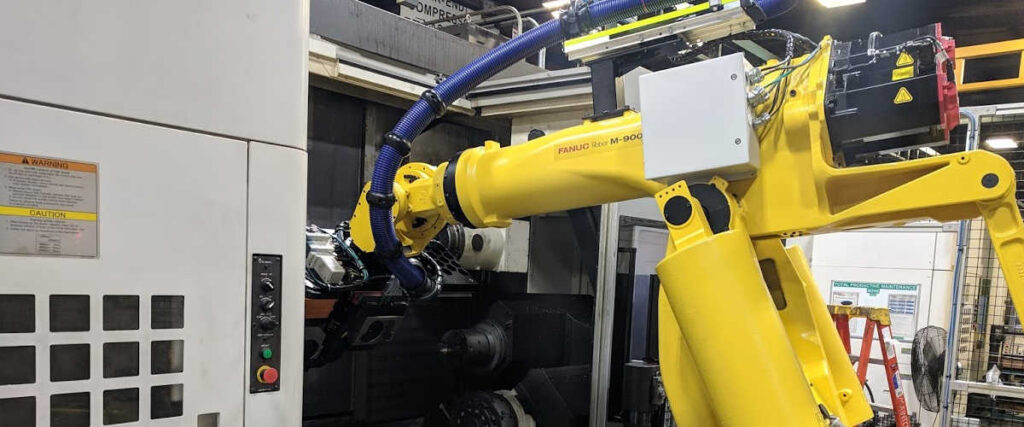
A practical automation system typically involves two components:
- A palletizing or fixturing setup that allows parts to move in and out of the machine with consistent positioning between cycles
- An external robotic arm that handles the loading and unloading.
For an investment in the range of $150,000, a shop can cover two machines, capture extended operating hours reliably, and begin moving the revenue-per-person number in a meaningful direction.
The Revenue Per Person Benchmark
The average engineer, tool maker, or machinist represents roughly $150,000 in annual cost when you account for wages, benefits, and overhead. For a healthy business, that employee needs to generate $250,000 or more in revenue — and most shops without a systematic automation approach fall well short of that.
Automation is key for breaking through that revenue per person ceiling. And we’re helping more and more manufacturers implement these solutions every day.
Case in Point: We recently worked with a mid-sized tool shop in Erie, Pennsylvania that has built its operation around high-quality machine tools and, with our help, a deliberate approach to automation. With 100 employees generating $60 million in annual revenue, they’re now achieving $600,000 per person. That result came from building an operation where every person in the building was supported by equipment and processes capable of multiplying what they could produce. So that the output of the business grew without the headcount having to grow with it.
Solutions for High-Mix, Low-Volume Shops
A common concern we hear from job shops is that automation only makes sense if you’re running the same part day after day. But there is still significant ROI to be made even on high-mix, low-volume operations.
High-mix job shops by nature require some additional setup with job changeovers. But some automation solutions don’t significantly increase set up time and you can make huge efficiency gains with small changes.
Pallet-based systems are designed with exactly this kind of variability in mind. Resetting between jobs doesn’t require extensive reprogramming or a dedicated automation engineer. For a team that already understands fixturing and workholding, the learning curve is a natural extension of what they already know how to do.
#1 Thing to Check Before Automating
Is your machine tool accurate and reliable enough? This is one of the most overlooked factors in automation planning, and one of the most important. Your machine tool needs to hold accuracy cycle after cycle. If it doesn’t hold accuracy when tended, you can’t expect it to hold accuracy when untended. Any effort to automate will be lost if you don’t have a solid machine tool.
This is why, at Maruka, we approach automation conversations differently than a pure automation integrator would. Because we also represent the machine tools at the center of these cells, we think about the full system from the start, matching the right machine platform to the right automation architecture so the accuracy and repeatability built into the equipment actually shows up in the finished parts.
Frequently Asked Questions About CNC Automation
How does CNC automation improve revenue per person?
Automation extends the hours a machine produces output without extending the hours a person works. When a machine runs untended during off-hours, that output is captured by the same team that loaded it at the end of the previous shift. This drives revenue per person upward without requiring additional headcount. The shops achieving $500,000 or more per person are doing it by ensuring the equipment around their people is working to its full capability, not by simply adding additional machines and machinists.
How much does off-the-shelf CNC automation typically cost?
A practical system covering fixturing, a robotic arm, and integration across one or two machines generally requires an investment in the range of $150,000. Most shops find the payback period shorter than anticipated, because the recovered output begins accumulating immediately once the system is running.
Does automation work for shops running high-mix, low-volume production?
Yes, this is one of the most common misconceptions of automation. Off-the-shelf automation is making this easier than ever. If you have a high-mix, low-volume production and are looking for ways to increase revenue without adding additional machines or machinists, our team can help find the right automation solution for you.
Do we need to run a third shift to see a return on automation?
Not at all. The goal with automation isn’t necessarily always lights-out manufacturing. It’s allowing each operator to manage more machines and more output simultaneously so the business captures more revenue from the same number of people, regardless of what the shift schedule looks like.
The Bottom Line
Automation doesn’t have to mean a complete transformation of your shop floor or a massive capital commitment. For most manufacturers, the path to a meaningfully higher revenue per person starts with a straightforward question: how many productive hours are your machines currently leaving on the table, and what would it take to start recovering them?
Maruka USA has been working alongside precision manufacturers across mold and die, aerospace, medical device, and automotive applications for decades. We bring the same approach to every conversation: understand the operation first, identify where the opportunity is, and then find the right solution to close that gap. And we don’t just point you in the right direction. We serve as your consultant, guiding you step by step through the entire process, from evaluating your current setup to final automation implementation.
Ready to start automating? Get in touch with our team.