







Automated 5-Axis Machining: What the Fanuc Robodrill Makes Possible for Your Shop
June 2, 2026
TOYO Si-7 Series: More Than Just a New Controller
September 4, 2026
Multi-Turret Lathe: More Parts Per Hour,
Lower Cost Per Part
If you’re running a precision job shop, the pressure to win more business while keeping costs in check is nothing new. The question is: are your machine tools helping or hurting the growth of your business
For shops doing mid-to-high volume turned parts with any level of complexity, a single turret lathe might be the quiet bottleneck that’s holding you back. You can hire more operators, optimize your cycle times, and still find yourself unable to compete on price with shops that have already made the move to multi-turret machining.
Single Turret vs Multi-Turret Lathe
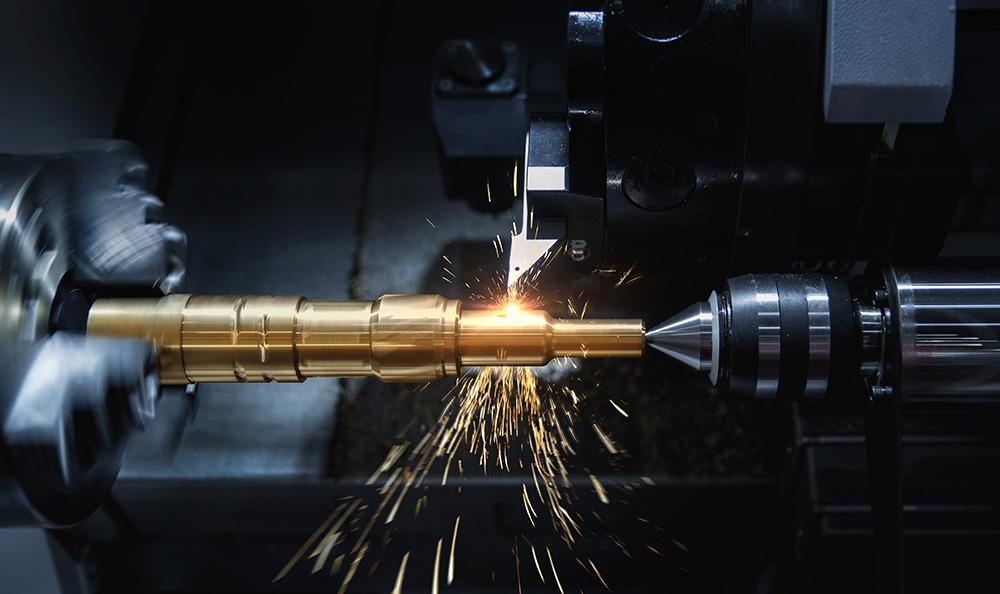
On a standard single turret lathe, the spindle rotates the part while a fixed tool performs one operation at a time. You face the part, rough turn it, drill it, finish drill it, and then transfer it to the sub-spindle to finish the back end. Every step happens in sequence, one after the other, with the spindle essentially idle during any operation it’s not directly involved in.
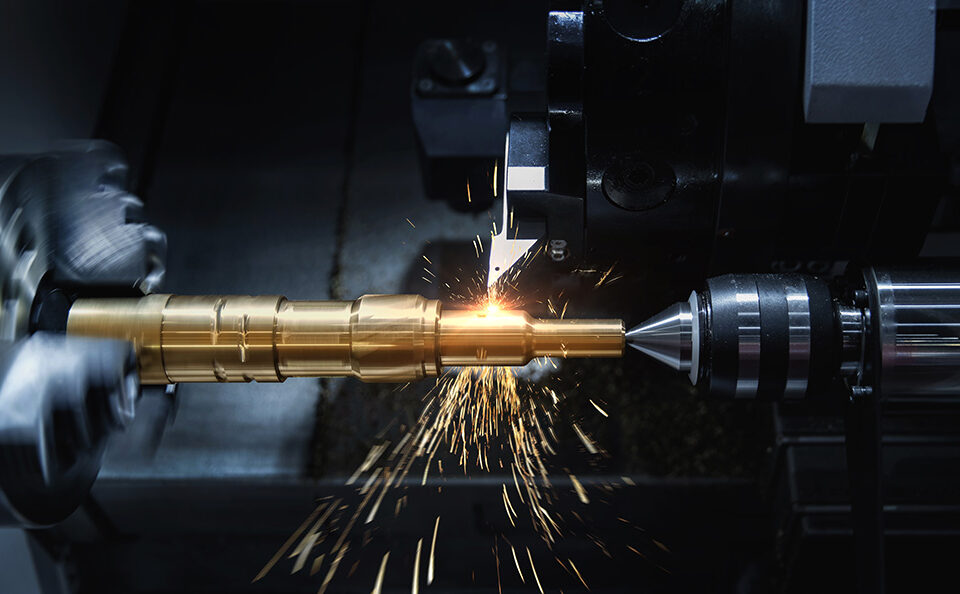
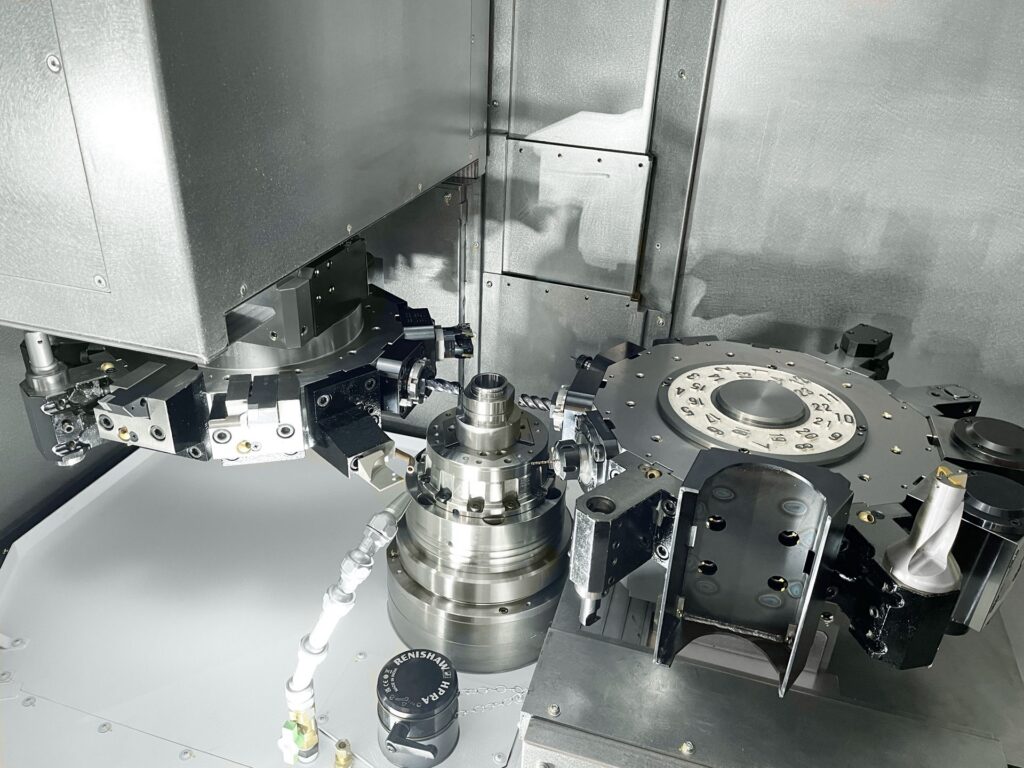
A multi-turret lathe changes the entire equation. Now you have two turrets, upper and lower, each capable of holding multiple tools and performing operations simultaneously. While the upper turret is roughing the front of the part on the main spindle, the lower turret can be finishing the back end on the sub-spindle at the same time. The machine virtually eliminates idle time.
Pair that with a bar feeder, which is standard on the majority of lathe setups for smaller diameter parts, and you have a machine that can run largely untended. A stack of bars loads in, the lathe feeds and machines and cuts off parts automatically, and your operator is freed up for setup, inspection, and other value-added work. This is a fundamentally different kind of automation than pick-and-place robotics. It’s built right into how the machine operates.
This setup is best suited for mid-to-high volume production, especially when parts have real complexity to them. If you’re making parts with milling, off-center drilling, multiple diameter holes, or tight tolerances, a single turret simply can’t keep up with what two turrets running simultaneously can accomplish.
Lower Per-Part Cost: What a Multi-Turret Lathe Delivers
On average, shops moving from a single turret to a twin turret configuration see roughly a 35% reduction in cycle time. That’s what happens in practice when both spindles are running and both turrets are working simultaneously. A part that takes five minutes on a single turret lathe can realistically run in two and a half minutes on a multi-turret machine. Do the quick math: at a five-minute cycle, you’re running 12 parts per hour. Cut that time in half and you’re producing 24 parts per hour on the same shift, with the same operator, in the same floor space.
When a customer brings us their drawings and says they need to be more competitive to win business, one of the first things we do is a cycle time study. We look at their current setup, analyze the part requirements, and come back with what we can realistically achieve. In many cases, what a customer has been running for nine minutes, we can demonstrate running in four.
Redundant Tooling and Untended Runtime: The Hidden Advantage
Tool wear is one of the most common reasons lathe production gets interrupted. Cutting inserts don’t last forever, and depending on what material you’re machining, they can wear out surprisingly fast. Hard materials like titanium are especially demanding. When an insert wears out mid-run on a single turret machine, you stop the machine, change the tool, restart, and re-establish your offsets. That interruption costs time and money every time it happens.
A twin turret machine addresses this with what’s called redundant tooling. Because you have significantly more tool positions available across two turrets, you can load a backup insert for the same operation right there in the turret. The machine is smart enough to track how many parts a given tool has run. Once that insert reaches its expected wear threshold, the control automatically calls up the redundant tool and keeps running without ever stopping.
But redundant tooling is only part of the story. The bigger operational advantage is setup time savings. With more tool positions available across two turrets, many shops load tooling for multiple jobs at once and run from one job to the next without ever stopping to change out tools. That kind of flexibility compounds quickly over a shift. It’s a significant reason why some customers specifically move to the three-turret NTY3, not just for cycle time, but because the tool capacity alone transforms how they schedule and manage production.
Overcoming the Learning Curve of a Multi-Turret Lathe
The most common pushback we hear when talking to shops about twin turret machines isn’t about cost. It’s about complexity. Going from a single turret mindset to a multi-turret environment can feel like a big leap, and that hesitation is understandable. The fear of collision is real.
This is where Nakamura-Tome’s engineering focus becomes a differentiator. Because Nakamura only builds multi-tasking lathes, they’ve developed proprietary software features specifically designed to make these complex machines more powerful and easier to operate. The most notable example is the Nakamura air bag system. In the event of a crash, the air bag absorbs the impact and protects the machine structure. In most cases the tool takes the damage, not the machine. For a shop running a high-value turning center around the clock, that protection is significant. No other builder in this category offers it.
Nakamura-Tome users also take advantage of verification and optimization software that lets programmers build out the entire job offline, generate all tool paths using solid models for both the part and the tooling, and watch a full simulation of what will happen inside the machine before a single chip is cut on the shop floor. You can see every tool movement, check every clearance, and identify any potential collision in the virtual environment first. There are a number of strong options in this space, and CAM providers can recommend and integrate the right solution based on your shop’s existing setup and workflow. For shops making the transition to their first multi-turret machine, having that virtual proving ground before you ever hit the start button is a genuine confidence builder.
Our team at Maruka is also there to support customers through that initial transition. When a new machine goes in and production is getting started, we work alongside the shop to help them get through the first run. The goal is to make sure that the first job comes off the machine right and that the team feels solid on the process before we step back.
In our experience, once a shop works through that initial learning curve and gets comfortable programming and running the machine, they’re done with single turret production for good. The productivity gap is simply too large to go back.
Why Nakamura-Tome Leads the Multi-Turret Category
When it comes to multi-turret and multitasking turning centers, nobody does it better.
Nakamura-Tome has been building precision CNC lathes and turning centers since 1960, and their entire engineering focus has always been the horizontal turning platform. That’s a deliberate choice that shows up in the quality and capability of every machine they produce. While other builders offer lathes as one part of a much broader catalog that also includes mills, grinders, and machining centers, Nakamura has spent decades perfecting one thing. That depth of focus shows up in the software and machine intelligence they’ve built around it. The air bag system is one example. The intuitive control interface is another. When your entire company is devoted to one type of machine, you get very good at making it work better for the people running it.
Here’s how the multi-turret lineup breaks down:
WT Series: The entry point into multi-turret turning. The WT features dual turrets with Y-axis capability on the upper turret, giving you the ability to mill and drill off-center. It’s a versatile, capable machine that makes an excellent transition point for shops moving away from single turret production.
WY Series: The WY adds Y-axis on both the upper and lower turrets, opening up off-center milling and drilling on both sides of the part simultaneously. Techniques like pinch milling become even more powerful with Y on both turrets, and the range of part geometry you can complete in a single setup expands significantly.
NTY3 Series: Three turrets. This is true high-volume production territory, common in the automotive industry where even fractions of a second of cycle time matter. With 47.2 inches between spindle faces, the NTY3 allows multiple tools in the cut at the same time across all three turrets without interference.
NTRX and MX Series: These machines combine a milling spindle with turrets, making them capable of extremely complex geometry in a single setup. Think medical implants, aerospace components, and other parts where the geometry demands both dedicated milling spindle capability and turning. These are for shops with in-house programming expertise tackling the most demanding part complexity in the market.
Frequently Asked Questions
How do I know if my shop is ready for a multi-turret lathe?
The best candidates are shops running mid-to-high volume turned parts with complexity — multiple diameters, off-center drilling, milling features, or tight tolerances. If you’re running the same part number repeatedly and your operator is constantly managing the machine rather than other tasks, that’s a strong signal. A good starting point is bringing us your drawings. We’ll run a cycle time study and tell you honestly whether a twin turret machine makes financial sense for your work.
Do I need an in-house programmer to run a multi-turret lathe?
Not necessarily. The WT Series, which is the most common entry point for shops making this transition, features conversational programming on the FANUC control, which significantly lowers the programming barrier. That said, more complex machines like the NTRX or MX Series do benefit from a dedicated programmer on staff. We work with shops at every skill level and help match the right machine to where your team actually is today, not where you hope to be.
How long does it take to see ROI on a multi-turret lathe?
It depends on your volume and current cycle times, but shops that are running parts repeatedly see ROI faster than most expect. When you double your parts per hour on the same shift with the same operator, the machine is essentially paying for itself through the revenue it generates. We walk every customer through the math before they buy so there are no surprises.
Ready to See What Your Parts Can Do?
If your shop is running mid-to-high volume turned parts on a single turret lathe, there’s a very good chance you’re leaving money on the table with every shift. The per-part cost gap between single and multi-turret production compounds over time, and the shops that have already made the move are widening that gap every day.
At Maruka USA, we don’t just quote you a machine and walk away. We start with your parts. We look at your drawings, run a cycle time analysis, and show you exactly what the numbers look like before you make any commitment. The investment makes sense faster than most owners expect, and the results speak for themselves. Contact us today to request a cycle time analysis for your parts and see what’s possible.